Patient Services
Santa Paula Hospital Continued Services Updates
Hello and Welcome!
This page is your central source for updates and the latest information about the Santa Paula Hospital.
As the HCA leadership works on the plan for continued services in this community, we are committed to keeping the community informed.
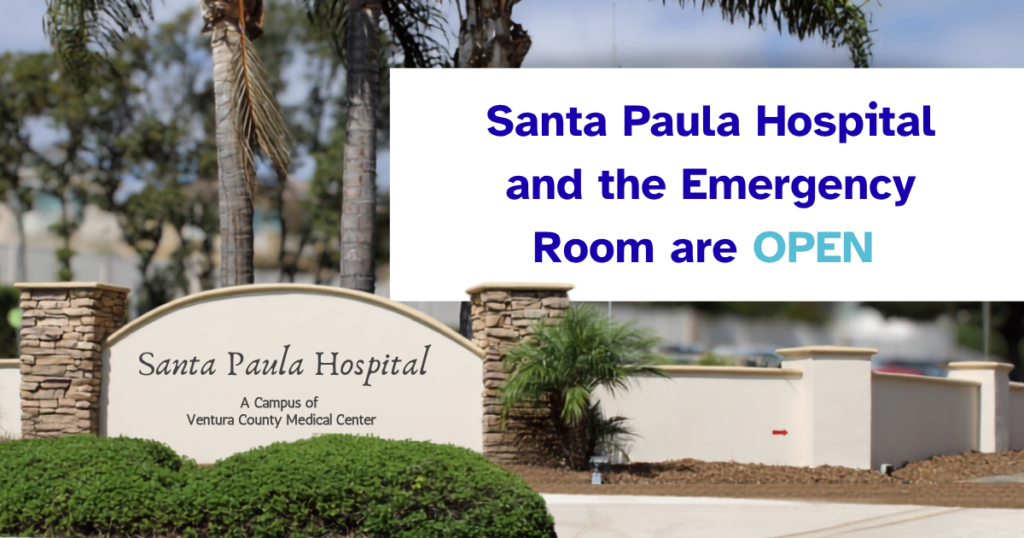
Santa Paula Hospital and the Emergency Room are open. HCA also has a broad range of essential health care services in the Santa Clara River Valley in Ambulatory Care, Behavioral Health, and Public Health listed below.
Please see the locations tab below for access to all HCA resources in the Santa Clara River Valley.
Please click on each location below for service details.
Emergency Department, Ambulatory Surgery, Inpatient Services, GI Lab
Primary and Specialty Care
Adult Mental Health Services, Substance Use Services, Youth and Family Mental Health Services
Women, Infant and Children Public Health Clinic
Primary and Specialty Care
Adult Mental Health Services, Youth and Family Mental Health Services
Specialty Care
Primary, Specialty Care, and PRIDE Clinic
Women, Infant, and Children Public Health Clinic
The Future of Healthcare in the Santa Clara River Valley: Our Commitment to Transparency, Reinvestment, and Care
For decades, the health and safety of the Santa Clara River Valley have been anchored by local medical care. As a community, we are facing an important transition regarding the future of Santa Paula Hospital. To build a stronger, more reliable healthcare system, Ventura County is committed to full transparency. This is the complete story of where we started, our extensive network of local care, and how we are investing in the economic and physical health of your neighborhood.
How We Got Here: The 2003 Acquisition and the Legacy Land Sale
The story of the County’s involvement began in December 2002. At that time, the private board running the Santa Paula Memorial Hospital announced an immediate financial crisis. The hospital was on the verge of closing its doors permanently due to decades of operating losses, a high number of uninsured patients, and low reimbursement rates.
Recognizing that, at the time, our community could not afford to lose its hospital, the neighbors mobilized, and Ventura County stepped in. In 2003, the County officially purchased the facility, bringing it under the Ventura County Medical Center (VCMC) license.
An important part of this history is the hospital land sale. The purchase of the hospital building and campus resulted in a $2.75 million transaction. Every dollar of those proceeds was strictly legally dedicated to resolving the legacy debts, outstanding liabilities, and immediate operational deficits left behind by the previous private hospital board. This financial rescue allowed the doors to remain open. For more than twenty years, the County has absorbed significant annual financial losses to keep the hospital operating, ensuring continuous care for the valley.
Our Deep Roots: The Existing County Healthcare Network
While the physical hospital building faces changes, it is vital to know that the Health Care Agency’s presence in the Santa Clara River Valley extends far beyond a single building. The County currently operates a wide and active network of health and social services designed to support you and your family right here in your neighborhood:
- Comprehensive Medical Clinics: We operate fully staffed outpatient medical centers, including the Fillmore Medical Clinic, Santa Paula Medical Clinic, and Santa Paula West Medical Clinic. These sites provide deep access to essential Primary Care and routine medical visits.
- Targeted Care and Specialty Clinics: The Santa Paula Hospital Clinic remains fully open and operational, focusing exclusively on providing convenient local access to vital specialty care and physician consultations.
- Robust Behavioral Health Services: Mind and body wellness are connected. In Fillmore, our Behavioral Health clinic provides adult mental health services, substance use recovery support, and youth and family mental health services. In Santa Paula, our Behavioral Health clinic offers dedicated outpatient care for adults, youth, and families.
- Public Health and Family Support: Public Health leads the WIC (Women, Infants, and Children) program in Santa Paula, providing vital nutrition, education, and health equity support to growing families and young children.
The Reality of an Aging Facility and Seismic Mandates
Santa Paula Hospital was built in 1963. Now more than 60 years old, the facility operates on an aging footprint. While the County has made continuous, routine maintenance repairs over the years, the building requires massive structural updates to keep up with modern medical technology.
More importantly, the State of California has established strict seismic (earthquake) safety mandates that all acute-care hospitals must meet by the year 2030. Because of the building’s age and original design, retrofitting the current structure to meet these heavy engineering laws is physically and financially impossible. For the safety of patients and staff during a major disaster, the current hospital building cannot legally provide inpatient care past 2030.
Addressing Your Concerns with Clear Facts
We know the community has many questions and feels that information has been slow to arrive. Healthcare planning involves complex legal, financial, and building regulations, which has kept our initial planning work quiet. We hear your concerns clearly, and we want to share the facts:
- Your Local Healthcare Access: Many neighbors asked how working families, seniors, and undocumented residents will get care. Our mission as the community safety net has not changed. We are completely committed to maintaining a robust, accessible network of services so no one is left behind.
- Patient Transportation Support: We understand that getting to medical appointments is a top priority for families in Santa Paula, Fillmore, and Piru. To address this, the County is actively evaluating comprehensive transportation support strategies to ensure patients can easily travel to and from care centers across our health system.
- Advanced Medical Transport: When seconds count, response matters. Today, our Emergency Medical Services (EMS) transit teams are equipped with cutting-edge medical technology. Patients receive immediate, advanced clinical care en-route while being transported safely to specialized regional trauma and emergency centers
A Commitment to Reinvestment and Community Stability
We understand deeply that Santa Paula Hospital is more than just a medical building, it is a vital economic pillar for our community, supporting local jobs, businesses, and families. The County will not leave the Santa Clara River Valley with nothing. We recognize both the healthcare impact and the broader economic footprint of this transition.
The County is fully committed to dollar-for-dollar community reinvestment. We are dedicated to replacing the aging facility with a modern infrastructure footprint that preserves healthcare access, anchors local jobs, and keeps our neighborhood economies strong and stable.
Driven by the Community: Our Strategic Path Forward
Our next steps are completely guided by data from the community. The County recently completed a thorough, targeted Community Health Needs Assessment specifically for the Santa Clara River Valley. This assessment gathered direct feedback, health trend data, and neighborhood demographics to show exactly what services local families use and need most.
The results of this assessment are driving the modern, strategic facility and service options currently under consideration by County leadership. All paths forward are tied directly to the long-term needs of the community, ensuring this valley remains supported, safe, and thriving.
Santa Paula Hospital is not closing tomorrow. The building will remain fully open, staffed, and safe throughout this entire planning period. 2030 is a hard legal deadline for the physical building, but it is also an opportunity to build a healthier, safer future. Every option we explore is tied directly to the long-term needs of the community, ensuring this valley remains supported, safe, and thriving for decades to come.
Shaping the Future of Care in the Santa Clara River Valley
For generations, when we thought about medical care in the Santa Clara River Valley (SCRV), we thought about the Santa Paula Hospital building. But healthcare has changed completely over the last twenty years. Today, staying healthy isn’t about how many hospital beds are in a building. It is about having quick, local access to doctors, family clinics, urgent care centers, and mental health support right in our neighborhoods.
To understand exactly what our residents need, Ventura County recently conducted a deep, data-driven Community Health Needs Assessment for Santa Paula, Fillmore, and Piru. We also looked closely at a Health Disparity Report to see how socioeconomic factors like language, income, and transport impact our Latino neighbors, who make up 80% of our valley’s population.
The facts show us that our community is using healthcare differently now. To provide the best, safest, and most stable care for our families, County leadership is preparing to make major decisions. Ahead of the upcoming Board of Supervisors (BOS) meeting in August 2026, we want to share the data we gathered and the potential paths forward being looked at to protect your health safety net.
Who We Are: A Vibrant Community with Unique Needs
Our valley is a unique and growing region of 55,213 people. According to the latest U.S. Census data, our population is distributed across three main neighborhoods:
- Santa Paula: 34,506 residents (63%)
- Fillmore: 18,803 residents (34%)
- Piru: 1,904 residents (3%)
Our families are tight-knit, averaging 3.3 people per household (compared to 2.95 countywide). We are also a young community: 25% of our neighbors are children and teenagers under the age of 18.
However, our Health Disparity Report shows that our valley faces unique economic hurdles that make accessing traditional healthcare difficult:
- Poverty Rates: In Santa Paula, 14.4% of residents live below the Federal Poverty Line, which is higher than the Ventura County average of 9.4%.
- Insurance Gaps: The uninsured rate in Santa Paula is 12.2%, meaning thousands of working families must pay out-of-pocket or rely on public safety nets like Medi-Cal.
- Language & Access Barriers: Because 80% of our valley’s population is Latino, our assessment looked closely at culturally tailored needs. Many residents shared that a lack of Spanish-speaking providers, high costs, or worries about documentation status cause some families to delay seeking care until a medical issue becomes severe.
Our community needs a healthcare system that eliminates these barriers by bringing affordable, bilingual, and accessible preventative care directly to where our families live and work.
The Data: How Our Community Actually Uses Healthcare
Many residents worry that changing how a traditional hospital building operates means losing healthcare. But the data shows that the most of the community has already transitioned away from using Santa Paula Hospital for overnight inpatient stays. Consider these critical facts found in our Health Profile:
- Inpatient Stays Are Dropping Fast
Over the last four years, the number of patients admitted into a hospital bed at Santa Paula Hospital has dropped by 23%. When residents of our valley do need to stay overnight in a hospital, 77% of them choose or are transferred to other regional facilities like Ventura County Medical Center (VCMC) or Community Memorial Hospital (CMH) in Ventura. Only 23% of local inpatient stays happen at Santa Paula Hospital.
- The Emergency Room is Being Used for Urgent Care
Our data tracked thousands of visits to the Santa Paula Hospital Emergency Department. The results show that 83% of all visits to the emergency room are actually for urgent and less-urgent cases (such as minor cuts, fevers, sprains, or asthma flares). These are issues that can be treated quickly without needing an expensive hospital bed.
True, life-saving emergencies (known as “Level 1 Resuscitation” cases) make up only 0.3% of the total volume.
- Where the Real Demand Is
While hospital beds sit empty, our local outpatient clinics are completely packed. Every year, the County’s local clinic network handles:
- Over 43,000 visits at our Fillmore and Santa Paula clinics.
- Over 29,000 visits for mental health and substance use support.
- Over 43,000 visits for the Women, Infants, and Children (WIC) public health program.
Our neighbors are clearly showing us what they need: they need robust, local, everyday medical services, family doctors, and quick walk-in care.
Chronic Diseases in Our Valley: Tailoring Care for Our Latino Families
When we look at the data from our recent Health Profile and Disparity Reports, we see a clear pattern: our families in the Santa Clara River Valley face much higher rates of long-term, chronic health conditions than the rest of Ventura County. Because 80% of our valley’s population is Latino, these health challenges deeply affect our neighborhood households.
Living with a long-term illness is difficult, but the data shows that a traditional hospital building is not the best place to manage these conditions. Chronic diseases require continuous, daily support, routine check-ups, and trusted, local doctors.
Here are the top three chronic health challenges identified in our valley’s data, and exactly how the proposed healthcare models are being tailored to fight them:
- The Diabetes Challenge
- The Data: Our community assessment shows that diabetes and blood sugar complications are a primary health concern across Santa Paula, Fillmore, and Piru. High rates of diabetes often lead to serious emergency room visits if families cannot get routine check-ups, regular lab work, or affordable medications.
- How We Are Tailoring Services: Under the potential Federally Qualified Health Center (FQHC) clinic and Medical Office Building (MOB) models currently being evaluated, one of the key recommendations under review is the addition of a dedicated Endocrinology (Diabetes Management) Track right here in the valley. If approved by the Board of Supervisors, this model is designed so that instead of having to drive to Ventura for a specialist, families would gain local access to bilingual diabetes educators, nutrition counseling, and continuous glucose monitor tracking. Furthermore, because FQHC frameworks are eligible for special federal funding, this approach aims to make life-saving insulin and supplies drastically more affordable, regardless of a patient’s insurance or immigration status.
- Heart Health & Hypertension (High Blood Pressure)
- The Data: Heart disease remains a leading cause of illness in our valley. The Disparity Report notes that many Latino residents experience delayed care for high blood pressure due to a lack of local specialists, language barriers, and the high cost of diagnostic testing. This lack of early tracking can turn manageable high blood pressure into a severe heart crisis.
- How We Are Tailoring Services: The proposed Advanced Urgent Care and health hub layouts feature a specialized Cardiology & Diagnostic Suite. By co-locating standard X-ray, lab processing, and advanced imaging (like CT scans) right next to walk-in clinics, our doctors can catch heart conditions early. Paramedics can route patients with minor heart concerns directly to local clinics for immediate monitoring, bypassing the stress and traffic of an “over the hill” emergency trip.
- Access to Mental Health & Wellness
- The Data: One of the most striking findings in our Disparity Report is that 10% of residents needed mental health care in the last 12 months but did not receive it. The top barriers cited by our Latino neighbors were:
- Not knowing where to find help.
- The high cost of therapy.
- A lack of culturally respectful, Spanish-speaking providers.
- How We Are Tailoring Services: We are breaking down these barriers by integrating mental health support directly into our primary care clinics. In the proposed models, Behavioral Health services will be co-located within the standard Medical Office Buildings. This means a patient can see their regular family doctor and be introduced to a bilingual mental health counselor in the exact same building during the same visit. This removes the stigma, eliminates extra travel, and ensures mind-and-body wellness are treated together.
Advanced Emergency Transit: Care Without Delay
One of the most common questions from the community is:
- “What happens if I have a severe emergency?”
- “How will I get to a hospital quickly with Highway 126 traffic?”
We want to reassure residents that our emergency safety net is stronger and faster than ever. When a serious emergency happens, you do not have to wait until you reach a physical hospital building to receive life-saving care:
- Care Starts Immediately: Our local ambulance teams and paramedics are highly trained to provide advanced, hospital-level medical care directly in the field and en-route. The moment you enter the ambulance, emergency treatments, medications, and monitoring begin without delay.
- Beating the Traffic: Our Emergency Medical Services (EMS) network utilizes advanced routing technology and dedicated communication channels to navigate local traffic patterns and transit times safely.
- Direct Access to Specialized Trauma Centers: For severe, life-threatening events like major car accidents, strokes, or complex trauma, state law already routes emergency ambulances directly to specialized regional trauma centers like VCMC or Los Robles in Thousand Oaks. These facilities are uniquely staffed 24/7 with specialized surgeons and technology to treat high-acuity trauma, which small community hospitals are not equipped to handle.
Community Input and Future Health Care Planning
As our health care system plans for this transition, we are committed to engaging with the communities we serve. Health care needs continue to evolve, and community voices are essential in helping shape the future of local services.
Over the coming months, health system leadership will provide opportunities for residents, patients, community organizations, and stakeholders to share their perspectives, concerns, and priorities. Feedback gathered through community meetings, outreach activities, and public engagement efforts will help inform future health care planning and ensure that services continue to meet the needs of our community.
We encourage all interested community members to participate and help guide the future of health care in the Santa Clara River Valley. As a public safety net health system, we are committed to listening to those who rely on our services and ensuring that future health care investments reflect the needs of our diverse community, particularly those facing barriers to care.
Attended Community Listening Sessions:
Santa Paula Hospital Blue Ribbon Meetings (Nov 2025 & Jan 2026), Healthcare Equity Advisory Council (Feb 2026), Santa Paula City Council and Santa Paula Unified School Board Joint Meeting (March 2026), Circle of Care Network (April 2026), & Santa Paula Latino Town Hall (May 2026)
We want to hear from you! If you have questions or feedback regarding Santa Paula Hospital or the transition of healthcare services in the Santa Clara River Valley, please share your thoughts with us. Community input is important,
Submit your questions and comments to Health Management Associates using the form below:
HMA Feedback
Community meetings will be scheduled throughout the planning and transition processes to provide updates, answer questions, and gather input from residents, patients, community organizations, and local stakeholders. These conversations will help inform future health care priorities and ensure that community perspectives are considered as we plan for the future of health care services in our region. Meeting dates, locations, and participation opportunities will be posted as they become available.
We will return to the Board of Supervisors in August 2026 with an updated assessment of options, associated costs, and recommended next steps.
We recognize that uncertainty can be challenging. We are committed to supporting staff throughout this process and providing timely, accurate information as decisions are evaluated and made. Leadership is confident in our ability to:
- Support staff through any operational transitions
- Provide clear guidance as plans develop
- Address concerns as early and transparently as possible
Staff input is valued, and your experience and insight are critical as we move forward.
Staff play an essential role in helping patients and community members understand what is happening.
- Services in the Santa Clara River Valley will continue
- Patient safety and access to care are the County’s top priorities
- Planning is ongoing and that updates will be shared as they become available
Questions, Concerns, and Feedback
A structured process is in place to ensure staff, patient, and community questions are heard and addressed. Staff are encouraged to:
- Report questions or concerns raised by patients or community members through established internal channels
- Share questions or concerns with supervisors or designated leadership contacts
- Flag recurring themes or issues so they can be addressed consistently and accurately
FAQS
Service Continuity & Access
I live in District 4 with a medically fragile child (trach/ventilator). How will Santa Paula, Fillmore, and Piru access emergency and outreach services? What is the plan to protect vulnerable residents?
We recognize the overwhelming worry and fear that comes with securing life-saving care for a vulnerable family member. We want to reassure you that the County and Health Care Agency will continue to provide services in the Santa Paula, Fillmore, and Piru communities. Serious emergencies, like major breathing crises, trauma, or strokes, will continue to be sent directly by ambulances to specialized centers like VCMC or CMH to keep patients safe. SPH will stay open until 2030.
Why would Santa Paula Hospital close or reduce services before a new location to replace it is finalized and ready for the community? We live in Piru and already travel very far for care.
We hear you, and we know that traveling from Piru or Fillmore makes getting care harder. California’s 2030 earthquake laws require hospitals to meet updated building standards. To prepare, we are actively designing a new care system to ensure uninterrupted medical services. Our goal is to maintain a strong healthcare presence along the Highway 126 corridor, keeping emergency and family services easily accessible for residents in Piru and Fillmore.
Inpatient volume is down 23%, and key units like the ICU and OB closed in 2024. Why has use gone down? Do ambulances bypass us, or is the data biased?
The numbers are real and reflect how modern healthcare works. Most people in the valley who need to stay overnight in a hospital, about 77% already choose or are sent to larger hospitals outside the valley. Real ambulance data shows that 80% of the trips to SPH are for lower-intensity needs, and less than half of one percent are major, life-threatening cases. Ambulances take critical cases to larger centers because that is where the advanced specialists are located.
Can you give data on the ER census and transfers? Are sick patients transferred mostly because specialty services were cut?
SPH has about 17,000 ER visits a year, but only 5.5% of those patients actually need to be admitted to a hospital bed. This low number shows that the ER mostly treats less-serious issues, like minor injuries or common illnesses. When patients are transferred out, it is not because of recent budget cuts. Patients continue to be transferred to ensure that they receive the best medical care for serious conditions like major trauma or heart attack that require specialized doctors and equipment.
What specific reforms are being implemented immediately? How are you going to recruit and retain physicians?
While the new modern health hub plan is in development, we are actively streamlining our current clinic workflows to improve your experience and reduce wait. Recruiting excellent physicians to small, rural hospitals is a challenge nationwide, as many physicians prefer to work in modern spaces with the latest advanced tools rather than in older buildings. This new project may help us attract top quality doctors to serve your families.
Fiscal Accountability & Use of Funds
The County bought SPH for $2.7M, which included land sold for $10M. The money made on that sale HAS to go back into 24-hour care in Santa Paula. How will you ensure citizens are not robbed?
The County purchased the hospital building and 13.5 acres for $2.75 million. The remaining 15.5 acres of the surrounding campus were sold by a court-appointed bankruptcy committee. This sale was used strictly to clear the past debts of the old hospital before the County stepped in and secured the facility as a public health-care safety net for the community. The County did not keep that $10 million. In fact, the County spent an extra $4.5 million of its own money just to fix and reopen the hospital in 2006.
We see losses at Santa Paula Hospital, but what are the losses at VCMC and how have total system losses changed?
SPH has been losing $7.5 million to $15 million annually due to low patient demand combined with high fixed operating costs. While the broader VCMC health system has historically absorbed these losses, the new federal law (HR1) will cut our healthcare funding by $400 million by 2031. Facing these massive system-wide cuts, we can no longer afford to spend millions to keep a nearly empty building open. Instead, every dollar saved will be redirected to where it matters most: direct, frontline, patient care.
Who is being held accountable for financial performance? What projects or programs may be delayed or canceled because of this?
The leadership of the Health Care Agency is fully accountable to the County CEO and the County Board of Supervisors and the public. To protect our healthcare safety net from massive federal funding cuts, we are evaluating every program. No decisions have been made to cancel specific local programs. The County is committed to ensure that health care services that are aligned with the needs for the residents of Santa Clara River Valley, are currently and will continue to be available.
Strategic Alternatives & Innovation
What about turning the building into a women’s wellness center instead of closing the OB unit? Can we build an “all-in-one” center like Kaiser or CMH?
This is an excellent suggestion, and it matches our vision. While we cannot keep the current building open as a full hospital due to earthquake laws, our plan is to ensure we have a mix of services that are congruent with the community needs. We have several years even a decade in the area. We have countless health statistics and utilization of the population in the Santa Clara River Valley. We will uses these historical trends to predict outcomes and usage of services to align care to meet residents’ needs. However, this location also presents challenges for residents in the Valley. Our goal is to find a location down the hill perhaps close to HWY 126 to make healthcare more accessible to residents throughout the valley.
Has HCA considered partnering with Kaiser, Dignity, or UCLA to provide hospital services? Can another agency take over if the County cannot?
We have looked closely at corporate and public-private partnerships. Large private systems like Kaiser or UCLA have strict requirements about where they build, and they look for high patient volumes that a small community like ours does not have. No other healthcare groups have expressed interest in taking over the current building because of the massive in excess of $25 million cost for earthquake safety upgrades.
Why not place the hospital in the middle of Santa Paula and Fillmore? Does Limoneira have land there, and would it qualify for rural hospital funding?
We did study a 25-acre parcel of land owned by the Limoneira Company for a replacement hospital. However, updated studies showed that building a brand-new hospital there would exceed the County’s appetite for investment and would perpetuate and already continuous financial losses. Also, highway access rules and land constraints mean a hospital could not be finished there before the 2030 legal deadline.
Why not organize local fundraisers (marathons, GoFundMe, dances) with Limoneira and local museums to raise money instead of waiting for state funds?
We love the passion and spirit of this community, and we want to be highly visible and collaborative with you. While local fundraisers show how much the community cares, the costs we are facing are simply too large for grass-roots fundraising. A new hospital requires up at minmum tens-of-millions to build and millions more each year to run. We must rely on major state funds, federal grants, and strategic property planning to secure that level of funding.
Re: Pg 9 Pie Chart (on the Santa Paula Hospital Presentation), what would you estimate the percentage would need to be to consider the new facility off the Hwy 126?
To build a facility right off Highway 126, the location must be highly accessible for residents traveling from Santa Paula, Fillmore, and Piru. We do not use a strict percentage rule. Instead, we look at traffic patterns, transit times, and safety on the highway. Any final site selection will focus on making sure the location is easy to reach for the maximum number of valley residents. Our goal is to be accessible to as many patients as possible. While we prioritize convenient locations, our final decision must balance these goals with what is practically available and can be sustainably maintained to provide you with high-quality, uninterrupted care.
Legislative & Political Pressure
What specifically are you doing to pressure our state legislative delegation and members of Congress for extra resources? What role can representatives play?
We are actively working with our state and federal lawmakers. Our representatives play a huge role by carrying our community’s voice to Sacramento and Washington, D.C. We are showing them real data about our rural valley population to fight for special grants and emergency funding. We are directly asking them to help fund our new clinical space and protect our local health network from federal budget cuts.
What are your suggestions on how to pressure the Board of Supervisors to take our community seriously? It feels like the community versus the Board.
The Board of Supervisors takes this community very seriously, which is why they ordered an in-depth study of the valley’s health needs rather than making quick decisions. You can make your voice heard by continuing to attend town halls, joining county public meetings, and sharing your personal healthcare stories. Our Agency is actively using your feedback to design new healthcare options that will be presented to the Board in August 2026. We want to work directly with, the community, to ensure leadership can make a fully informed final decision about the continuation of care in the valley.
How will the agency compete with private systems? How are all agencies collaborating to get a good return on investment (ROI)?
We compete by continuing to provide modern, high-quality healthcare right in our local neighborhoods by shifting resources out of underused, expensive buildings and investing them directly into the community. Through close partnerships with local businesses, schools, and government, we are creating a more connected network of support to improve public health. This approach allows us to focus heavily on preventive care, diabetes management, and proactive wellness programs that keep everyone healthy, thriving, and out of the hospital.
Planning & Regulatory Deadlines
Why weren’t County resources used for a one-time earthquake retrofit? Why not maintain a state-of-the-art emergency/urgent care hospital and close only other units?
Upgrading our older facility to meet strict seismic safety standards and address deferred maintenance is a highly complex and costly challenge. Bringing the current building up to basic earthquake legal requirements would require an investment exceeding $25 million. Additionally, state licensing laws mandate that a hospital maintain expensive, 24/7 departments, regardless of how few patients utilize them. Meeting these staffing and operational requirements would result in an ongoing loss of over $7.5 million every year, which would unfortunately divert vital funding away from our local community clinics and outpatient services.
For 10 years we have heard about plans for a new hospital in East Santa Paula. Why are those plans on hold? What is the actual HCA plan?
Early plans for a new hospital on the Limoneira land were thoroughly studied. However, an internal analysis completed in 2024 and updated in 2025 revealed that a new hospital has a large span of cost from tens to hundres of millions to build and would lose more than $7.5 million a year. It would require constant public subsidies to survive. HCA’s goal is to present a realistic, high-quality, and financially secure plan to the Board in August 2026 that can be successfully built and sustained to serve our patients long-term.
Why hasn’t a third-party provider option been pursued sooner when the 2030 deadline has been known since 2008?
The County has been actively exploring long-term strategic solutions for years, beginning with independent expert assessments in 2019. We are currently working alongside healthcare consultants at Health Management Associates (HMA) to analyze and build practical, sustainable care models that are completely under County control. Finding a third-party partner is incredibly difficult because every hospital system in California is facing the exact same expensive 2030 earthquake deadlines. Our priority is making sure your medical care is continuous and uninterrupted. By focusing on realistic and County-controlled models, we are working to prevent any disruptions to your health services.
Myth vs Fact
How and why would you not invest any further in your adopted hospital when it would further burden other hospitals and impact our community?
We hear you, and we are not stopping our investments in the valley’s health. We are deeply committed to your health, but sinking millions into a 60-year-old building that will not legally qualify as a hospital in less than four years is not a good use of public funds. By avoiding temporary fixes on the old site, we protect vital funding for our neighborhood clinics and doctors. Instead, we are investing in a brand-new, modern facility designed to provide exceptional care for decades to come.
To support transparency and keep the community informed, presentations, informational materials, and community briefings related to the hospital closure and the Santa Clara River Valley transition will be posted in this section as they become available. These materials provide updates on planning efforts, timelines, community engagement activities, and future health care services in the region.
Access presentations below:
Santa Clara River Valley Services Update, June 2026, English
Actualización de Sobre Servicios en el Valle del río Santa Clara, Junio 2026, Español